

Saturday, September 21, 2013

Tuesday, March 19, 2013
A Sad Bit of Nicaraguan History with the Catholic Church
Pope Francis, CIA and ‘Death Squads’
Exclusive: In the 1970s, Father Jorge Bergoglio faced a moment of truth: Would he stand up to Argentina’s military neo-Nazis “disappearing” thousands including priests, or keep his mouth shut and his career on track? Like many other Church leaders, Pope Francis took the safe route, Robert Parry reports.
By Robert Parry
The election of Argentine Cardinal Jorge Bergoglio as Pope Francis brings back into focus the troubling role of the Catholic hierarchy in blessing much of the brutal repression that swept Latin America in the 1970s and 1980s, killing and torturing tens of thousands of people including priests and nuns accused of sympathizing with leftists.
The Vatican’s fiercely defensive reaction to the reemergence of these questions as they relate to the new Pope also is reminiscent of the pattern of deceptive denials that became another hallmark of that era when propaganda was viewed as an integral part of the “anticommunist” struggles, which were often supported financially and militarily by the U.S. Central Intelligence Agency.
 It appears that Bergoglio, who was head of the Jesuit order in Buenos Aires during Argentina’s grim “dirty war,” mostly tended to his bureaucratic rise within the Church as Argentine security forces “disappeared” some 30,000 people for torture and murder from 1976 to 1983, including 150 Catholic priests suspected of believing in “liberation theology.”
Much as Pope Pius XII didn’t directly challenge the Nazis during the Holocaust, Father Bergoglio avoided any direct confrontation with the neo-Nazis who were terrorizing Argentina. Pope Francis’s defenders today, like apologists for Pope Pius, claim he did intervene quietly to save some individuals.
But no one asserts that Bergoglio stood up publicly against the “anticommunist” terror, as some other Church leaders did in Latin America, most notably El Salvador’s Archbishop Oscar Romero who then became a victim of right-wing assassins in 1980.
Indeed, the predominant role of the Church hierarchy – from the Vatican to the bishops in the individual countries – was to give political cover to the slaughter and to offer little protection to the priests and nuns who advocated “liberation theology,” i.e. the belief that Jesus did not just favor charity to the poor but wanted a just society that shared wealth and power with the poor.
In Latin America with its calcified class structure of a few oligarchs at one end and many peasants at the other, that meant reforms, such as land redistribution, literacy programs, health clinics, union rights, etc. But those changes were fiercely opposed by the local oligarchs and the multinational corporations that profited from the cheap labor and inequitable land distribution.
So, any reformers of any stripe were readily labeled “communists” and were made the targets of vicious security forces, often trained and indoctrinated by “anticommunist” military officers at the U.S.-run School of the Americas. The primary role of the Catholic hierarchy was to urge the people to stay calm and support the traditional system.
It is noteworthy that the orchestrated praise for Pope Francis in the U.S. news media has been to hail Bergoglio’s supposedly “humble” personality and his “commitment to the poor.” However, Bergoglio’s approach fits with the Church’s attitude for centuries, to give “charity” to the poor while doing little to change their cruel circumstances – as Church grandees hobnob with the rich and powerful.
Another Pope Favorite
Pope John Paul II, another favorite of the U.S. news media, shared this classic outlook. He emphasized conservative social issues, telling the faithful to forgo contraceptives, treating women as second-class Catholics and condemning homosexuality. He promoted charity for the poor and sometimes criticized excesses of capitalism, but he disdained leftist governments that sought serious economic reforms.
Elected in 1978, as right-wing “death squads” were gaining momentum across Latin America, John Paul II offered little protection to left-leaning priests and nuns who were targeted. He rebuffed Archbishop Romero’s plea to condemn El Salvador’s right-wing regime and its human rights violations. He stood by as priests were butchered and nuns were raped and killed.
Instead of leading the charge for real economic and political change in Latin America, John Paul II denounced “liberation theology.” During a 1983 trip to Nicaragua – then ruled by the leftist Sandinistas – the Pope condemned what he called the “popular Church” and would not let Ernesto Cardenal, a priest and a minister in the Sandinista government, kiss the papal ring. He also elevated clerics like Bergoglio who didn’t protest right-wing repression.
John Paul II appears to have gone even further, allowing the Catholic Church in Nicaragua to be used by the CIA and Ronald Reagan’s administration to finance and organize internal disruptions while the violent Nicaraguan Contras terrorized northern Nicaraguan towns with raids notorious for rape, torture and extrajudicial executions.
The Contras were originally organized by an Argentine intelligence unit that emerged from the country’s domestic “dirty war” and was taking its “anticommunist” crusade of terror across borders. After Reagan took office in 1981, he authorized the CIA to join with Argentine intelligence in expanding the Contras and their counterrevolutionary war.
A key part of Reagan’s Contra strategy was to persuade the American people and Congress that the Sandinistas represented a repressive communist dictatorship that persecuted the Catholic Church, aimed to create a “totalitarian dungeon,” and thus deserved violent overthrow.
A special office inside the National Security Council, headed by longtime CIA disinformation specialist Walter Raymond Jr., pushed these propaganda “themes” domestically. Raymond’s campaign exploited examples of tensions between the Catholic hierarchy and the Sandinista government as well as with La Prensa, the leading opposition newspaper.
To make the propaganda work with Americans, it was important to conceal the fact that elements of the Catholic hierarchy and La Prensa were being financed by the CIA and were coordinating with the Reagan administration’s destabilization strategies. [See Robert Parry’s Lost History.]
Evidence of Payments
In 1988, I discovered evidence of this reality while working as a correspondent for Newsweek magazine. At the time, the Iran-Contra scandal had undermined the case for spending more U.S. money to arm the Contras. But the Reagan administration continued to beat the propaganda drums by highlighting the supposed persecution of Nicaragua’s internal opposition.
To fend off U.S. hostility, which also included a harsh economic embargo, the Sandinistas announced increased political freedoms. But that represented only a new opportunity for Washington to orchestrate more political disruptions, which would either destabilize the government further or force a crackdown that could then be cited in seeking more Contra aid.
Putting the Sandinistas in this “inside-outside” vise had always been part of the CIA strategy, but with a crumbling economy and more U.S. money pouring into the opposition groups, the gambit was beginning to work.
Yet, it was crucial to the plan that the CIA’s covert relationship with Nicaragua’s internal opposition remain secret, not so much from the Sandinistas, who had detailed intelligence about this thoroughly penetrated operation, but from the American people. The U.S. public would get outraged at Sandinista reprisals against these “independent” groups only if the CIA’s hand were kept hidden.
A rich opportunity for the Reagan administration presented itself in summer 1988 when a new spasm of Contra ambushes killed 17 Nicaraguans and the anti-Sandinista internal opposition staged a violent demonstration in the town of Nandaime, a protest that Sandinista police dispersed with tear gas.
Reacting to the renewed violence, the Sandinistas closed down La Prensa and the Catholic Church’s radio station – both prime vehicles for anti-Sandinista propaganda. The Nicaraguan government also expelled U.S. Ambassador Richard Melton and seven other U.S. Embassy personnel for allegedly coordinating the disorders.
Major U.S. news outlets, which had accepted their role treating the Sandinistas as “designated enemies” of the United States, roared in outrage, and the U.S. Congress condemned the moves by a margin of 94-4 in the Senate and 385-18 in the House.
Melton then testified before the Senate Intelligence Committee first in secret and then in public, struggling to hide the open secret in Washington that Nicaragua’s internal opposition, like the Contras, was getting covert help from the U.S. government.
When asked by a senator in public session about covert American funding to the opposition, Melton dissembled awkwardly: “As to other activities that might be conducted, that’s – they were discussed – that would be discussed yesterday in the closed hearing.”
When pressed by Sen. Howard Metzenbaum on whether the embassy provided “encouragement – financial or otherwise – of dissident elements,” Melton responded stiffly: “The ambassador in any post is the principal representative of the U.S. government. And in that capacity, fulfills those functions.” He then declined to discuss “activities of an intelligence nature” in open session.
On the Payroll
In other words, yes, the U.S. government was covertly organizing and funding the activities of the supposedly “independent” internal opposition in Nicaragua. And, according to more than a dozen sources that I interviewed inside the Contra movement or close to U.S. intelligence, the Reagan administration had funneled CIA money to virtually every segment of the internal opposition, from the Catholic Church to La Prensa to business and labor groups to political parties.
“We’ve always had the internal opposition on the CIA payroll,” one U.S. government official said. The CIA’s budget line for Nicaraguan political action – separate from Contra military operations – was about $10 million a year, my sources said. I learned that the CIA had been using the Church and Cardinal Miguel Obando y Bravo to funnel money into Nicaragua.
Obando was a plodding but somewhat complex character. In the 1970s, he had criticized the repression of the Somoza dictatorship and expressed some sympathy for the young Sandinista revolutionaries who were trying to bring social and economic changes to Nicaragua.
However, after the murder of El Salvador’s Archbishop Romero in 1980 and Pope John Paul II’s repudiation of “liberation theology,” Obando shifted clumsily into the anti-Sandinista camp, attacking the “people’s church” and accusing the Sandinistas of “godless communism.”
On May 25, 1985, he was rewarded when the Pope named him Cardinal for Central America. Then, despite mounting evidence of Contra atrocities, Obando traveled to the United States in January 1986 and threw his support behind a renewal of military aid to the Contras.
All this made a lot more sense after factoring in that Obando had essentially been put onto the CIA’s payroll. The CIA funding for Nicaragua’s Catholic Church was originally unearthed in 1985 by the congressional intelligence oversight committees, which then insisted that the money be cut off to avoid compromising Obando further.
But the funding was simply transferred to another secret operation headed by White House aide Oliver North. In fall 1985, North earmarked $100,000 of his privately raised money to go to Obando for his anti-Sandinista activities, I learned from my sources.
I was also told that the CIA’s support for Obando and the Catholic hierarchy went through a maze of cut-outs in Europe, apparently to give Obando deniability. But one well-placed Nicaraguan exile said he had spoken with Obando about the money and the Cardinal had expressed fear that his past receipt of CIA funding would come out.
What to Do?
Discovering this CIA funding of Nicaragua’s Catholic Church presented professional problems for me at Newsweek, where my senior editors were already making clear that they sympathized with the Reagan administration’s muscular foreign policy and felt that the Iran-Contra scandal had gone too far in undermining U.S. interests.
But what was the right thing for an American journalist to do with this information? Here was a case in which the U.S. government was misleading the American public by pretending that the Sandinistas were cracking down on the Catholic Church and the internal opposition without any justification. Plus, this U.S. propaganda was being used to make the case in Congress for an expanded war in which thousands of Nicaraguans were dying.
However, if Newsweek ran the story, it would put CIA assets, including Cardinal Obando, in a dicey situation, possibly even life-threatening. So, when I presented the information to my bureau chief, Evan Thomas, I made no recommendation on whether we should publish or not. I just laid out the facts as I had ascertained them. To my surprise, Thomas was eager to go forward.
Newsweek contacted its Central America correspondent Joseph Contreras, who outlined our questions to Obando’s aides and prepared a list of questions to present to the Cardinal personally. However, when Contreras went to Obando’s home in a posh suburb of Managua, the Cardinal literally evaded the issue.
As Contreras later recounted in a cable back to Newsweek in the United States, he was approaching the front gate when it suddenly swung open and the Cardinal, sitting in the front seat of his burgundy Toyota Land Cruiser, blew past.
As Contreras made eye contact and waved the letter, Obando’s driver gunned the engine. Contreras jumped into his car and hastily followed. Contreras guessed correctly that Obando had turned left at one intersection and headed north toward Managua.
Contreras caught up to the Cardinal’s vehicle at the first stop-light. The driver apparently spotted the reporter and, when the light changed, sped away, veering from lane to lane. The Land Cruiser again disappeared from view, but at the next intersection, Contreras turned right and spotted the car pulled over, with its occupants presumably hoping that Contreras had turned left.
Quickly, the Cardinal’s vehicle pulled onto the road and now sped back toward Obando’s house. Contreras gave up the chase, fearing that any further pursuit might appear to be harassment. Several days later, having regained his composure, the Cardinal finally met with Contreras and denied receiving any CIA money. But Contreras told me that Obando’s denial was unconvincing.
Newsweek drafted a version of the story, making it appear as if we weren’t sure of the facts about Obando and the money. When I saw a “readback” of the article, I went into Thomas’s office and said that if Newsweek didn’t trust my reporting, we shouldn’t run the story at all. He said that wasn’t the case; it was just that the senior editors felt more comfortable with a vaguely worded story.
Hot Water
We ended up in hot water with the Reagan administration and right-wing media attack groups anyway. Accuracy in Media lambasted me, in particular, for going with such a sensitive story without being sure of the facts (which, of course, I was).
Thomas was summoned to the State Department where Assistant Secretary of State Elliott Abrams heaped more criticism on me though not denying the facts of our story. Newsweek also agreed, in the face of right-wing pressure, to subject me and the article to an internal investigation, which quietly reconfirmed the facts of the story.
Despite this corroboration, the incident damaged my relations with senior Newsweek editors, particularly executive editor Maynard Parker who saw himself as part of the New York/Washington foreign policy establishment and was deeply hostile to the Iran-Contra scandal, which I had helped expose.
As for Obando, the Sandinistas did nothing to punish him for his collaboration with the CIA and he gradually evolved more into a figure of reconciliation than confrontation. However, the hyper-secretive Vatican has refused to open its archives for any serious research into its relationship with the CIA and other Western intelligence services.
Whenever allegations do arise about the Catholic Church’s hierarchy winking and nodding at the kinds of human rights atrocities that claimed hundreds of thousands of lives in Latin America during the 1970s and 1980s, the Vatican PR department lashes out with sternly worded denials.
That practice is playing out again in the days after the election of Pope Francis I. Rather than a serious and reflective assessment of the actions (and inactions) of Cardinal Bergoglio, Cardinal Obando, Pope John Paul II and other Church leaders during those dark days of torture and murder, the Vatican simply denounces all allegations as “slander,” “calumny” and politically motivated lies.
[For a limited time, you can purchase Robert Parry’s trilogy on the Bush family for only $34. For details,click here.]
Investigative reporter Robert Parry broke many of the Iran-Contra stories for The Associated Press and Newsweek in the 1980s. You can buy his new book, America’s Stolen Narrative, either in print here or as an e-book (from Amazon and barnesandnoble.com).
By Robert Parry
The election of Argentine Cardinal Jorge Bergoglio as Pope Francis brings back into focus the troubling role of the Catholic hierarchy in blessing much of the brutal repression that swept Latin America in the 1970s and 1980s, killing and torturing tens of thousands of people including priests and nuns accused of sympathizing with leftists.
The Vatican’s fiercely defensive reaction to the reemergence of these questions as they relate to the new Pope also is reminiscent of the pattern of deceptive denials that became another hallmark of that era when propaganda was viewed as an integral part of the “anticommunist” struggles, which were often supported financially and militarily by the U.S. Central Intelligence Agency.
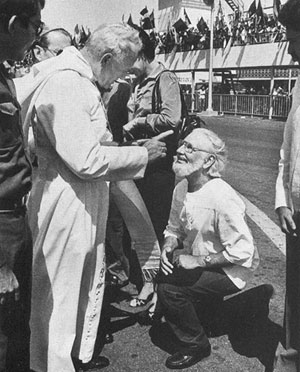
Pope John Paul II reprimanding Father Ernesto Cardenal at Managua Airport for Cardenal’s support of “liberation theology” and his work with the Sandinista government.
Much as Pope Pius XII didn’t directly challenge the Nazis during the Holocaust, Father Bergoglio avoided any direct confrontation with the neo-Nazis who were terrorizing Argentina. Pope Francis’s defenders today, like apologists for Pope Pius, claim he did intervene quietly to save some individuals.
But no one asserts that Bergoglio stood up publicly against the “anticommunist” terror, as some other Church leaders did in Latin America, most notably El Salvador’s Archbishop Oscar Romero who then became a victim of right-wing assassins in 1980.
Indeed, the predominant role of the Church hierarchy – from the Vatican to the bishops in the individual countries – was to give political cover to the slaughter and to offer little protection to the priests and nuns who advocated “liberation theology,” i.e. the belief that Jesus did not just favor charity to the poor but wanted a just society that shared wealth and power with the poor.
In Latin America with its calcified class structure of a few oligarchs at one end and many peasants at the other, that meant reforms, such as land redistribution, literacy programs, health clinics, union rights, etc. But those changes were fiercely opposed by the local oligarchs and the multinational corporations that profited from the cheap labor and inequitable land distribution.
So, any reformers of any stripe were readily labeled “communists” and were made the targets of vicious security forces, often trained and indoctrinated by “anticommunist” military officers at the U.S.-run School of the Americas. The primary role of the Catholic hierarchy was to urge the people to stay calm and support the traditional system.
It is noteworthy that the orchestrated praise for Pope Francis in the U.S. news media has been to hail Bergoglio’s supposedly “humble” personality and his “commitment to the poor.” However, Bergoglio’s approach fits with the Church’s attitude for centuries, to give “charity” to the poor while doing little to change their cruel circumstances – as Church grandees hobnob with the rich and powerful.
Another Pope Favorite
Pope John Paul II, another favorite of the U.S. news media, shared this classic outlook. He emphasized conservative social issues, telling the faithful to forgo contraceptives, treating women as second-class Catholics and condemning homosexuality. He promoted charity for the poor and sometimes criticized excesses of capitalism, but he disdained leftist governments that sought serious economic reforms.
Elected in 1978, as right-wing “death squads” were gaining momentum across Latin America, John Paul II offered little protection to left-leaning priests and nuns who were targeted. He rebuffed Archbishop Romero’s plea to condemn El Salvador’s right-wing regime and its human rights violations. He stood by as priests were butchered and nuns were raped and killed.
Instead of leading the charge for real economic and political change in Latin America, John Paul II denounced “liberation theology.” During a 1983 trip to Nicaragua – then ruled by the leftist Sandinistas – the Pope condemned what he called the “popular Church” and would not let Ernesto Cardenal, a priest and a minister in the Sandinista government, kiss the papal ring. He also elevated clerics like Bergoglio who didn’t protest right-wing repression.
John Paul II appears to have gone even further, allowing the Catholic Church in Nicaragua to be used by the CIA and Ronald Reagan’s administration to finance and organize internal disruptions while the violent Nicaraguan Contras terrorized northern Nicaraguan towns with raids notorious for rape, torture and extrajudicial executions.
The Contras were originally organized by an Argentine intelligence unit that emerged from the country’s domestic “dirty war” and was taking its “anticommunist” crusade of terror across borders. After Reagan took office in 1981, he authorized the CIA to join with Argentine intelligence in expanding the Contras and their counterrevolutionary war.
A key part of Reagan’s Contra strategy was to persuade the American people and Congress that the Sandinistas represented a repressive communist dictatorship that persecuted the Catholic Church, aimed to create a “totalitarian dungeon,” and thus deserved violent overthrow.
A special office inside the National Security Council, headed by longtime CIA disinformation specialist Walter Raymond Jr., pushed these propaganda “themes” domestically. Raymond’s campaign exploited examples of tensions between the Catholic hierarchy and the Sandinista government as well as with La Prensa, the leading opposition newspaper.
To make the propaganda work with Americans, it was important to conceal the fact that elements of the Catholic hierarchy and La Prensa were being financed by the CIA and were coordinating with the Reagan administration’s destabilization strategies. [See Robert Parry’s Lost History.]
Evidence of Payments
In 1988, I discovered evidence of this reality while working as a correspondent for Newsweek magazine. At the time, the Iran-Contra scandal had undermined the case for spending more U.S. money to arm the Contras. But the Reagan administration continued to beat the propaganda drums by highlighting the supposed persecution of Nicaragua’s internal opposition.
To fend off U.S. hostility, which also included a harsh economic embargo, the Sandinistas announced increased political freedoms. But that represented only a new opportunity for Washington to orchestrate more political disruptions, which would either destabilize the government further or force a crackdown that could then be cited in seeking more Contra aid.
Putting the Sandinistas in this “inside-outside” vise had always been part of the CIA strategy, but with a crumbling economy and more U.S. money pouring into the opposition groups, the gambit was beginning to work.
Yet, it was crucial to the plan that the CIA’s covert relationship with Nicaragua’s internal opposition remain secret, not so much from the Sandinistas, who had detailed intelligence about this thoroughly penetrated operation, but from the American people. The U.S. public would get outraged at Sandinista reprisals against these “independent” groups only if the CIA’s hand were kept hidden.
A rich opportunity for the Reagan administration presented itself in summer 1988 when a new spasm of Contra ambushes killed 17 Nicaraguans and the anti-Sandinista internal opposition staged a violent demonstration in the town of Nandaime, a protest that Sandinista police dispersed with tear gas.
Reacting to the renewed violence, the Sandinistas closed down La Prensa and the Catholic Church’s radio station – both prime vehicles for anti-Sandinista propaganda. The Nicaraguan government also expelled U.S. Ambassador Richard Melton and seven other U.S. Embassy personnel for allegedly coordinating the disorders.
Major U.S. news outlets, which had accepted their role treating the Sandinistas as “designated enemies” of the United States, roared in outrage, and the U.S. Congress condemned the moves by a margin of 94-4 in the Senate and 385-18 in the House.
Melton then testified before the Senate Intelligence Committee first in secret and then in public, struggling to hide the open secret in Washington that Nicaragua’s internal opposition, like the Contras, was getting covert help from the U.S. government.
When asked by a senator in public session about covert American funding to the opposition, Melton dissembled awkwardly: “As to other activities that might be conducted, that’s – they were discussed – that would be discussed yesterday in the closed hearing.”
When pressed by Sen. Howard Metzenbaum on whether the embassy provided “encouragement – financial or otherwise – of dissident elements,” Melton responded stiffly: “The ambassador in any post is the principal representative of the U.S. government. And in that capacity, fulfills those functions.” He then declined to discuss “activities of an intelligence nature” in open session.
On the Payroll
In other words, yes, the U.S. government was covertly organizing and funding the activities of the supposedly “independent” internal opposition in Nicaragua. And, according to more than a dozen sources that I interviewed inside the Contra movement or close to U.S. intelligence, the Reagan administration had funneled CIA money to virtually every segment of the internal opposition, from the Catholic Church to La Prensa to business and labor groups to political parties.
“We’ve always had the internal opposition on the CIA payroll,” one U.S. government official said. The CIA’s budget line for Nicaraguan political action – separate from Contra military operations – was about $10 million a year, my sources said. I learned that the CIA had been using the Church and Cardinal Miguel Obando y Bravo to funnel money into Nicaragua.
Obando was a plodding but somewhat complex character. In the 1970s, he had criticized the repression of the Somoza dictatorship and expressed some sympathy for the young Sandinista revolutionaries who were trying to bring social and economic changes to Nicaragua.
However, after the murder of El Salvador’s Archbishop Romero in 1980 and Pope John Paul II’s repudiation of “liberation theology,” Obando shifted clumsily into the anti-Sandinista camp, attacking the “people’s church” and accusing the Sandinistas of “godless communism.”
On May 25, 1985, he was rewarded when the Pope named him Cardinal for Central America. Then, despite mounting evidence of Contra atrocities, Obando traveled to the United States in January 1986 and threw his support behind a renewal of military aid to the Contras.
All this made a lot more sense after factoring in that Obando had essentially been put onto the CIA’s payroll. The CIA funding for Nicaragua’s Catholic Church was originally unearthed in 1985 by the congressional intelligence oversight committees, which then insisted that the money be cut off to avoid compromising Obando further.
But the funding was simply transferred to another secret operation headed by White House aide Oliver North. In fall 1985, North earmarked $100,000 of his privately raised money to go to Obando for his anti-Sandinista activities, I learned from my sources.
I was also told that the CIA’s support for Obando and the Catholic hierarchy went through a maze of cut-outs in Europe, apparently to give Obando deniability. But one well-placed Nicaraguan exile said he had spoken with Obando about the money and the Cardinal had expressed fear that his past receipt of CIA funding would come out.
What to Do?
Discovering this CIA funding of Nicaragua’s Catholic Church presented professional problems for me at Newsweek, where my senior editors were already making clear that they sympathized with the Reagan administration’s muscular foreign policy and felt that the Iran-Contra scandal had gone too far in undermining U.S. interests.
But what was the right thing for an American journalist to do with this information? Here was a case in which the U.S. government was misleading the American public by pretending that the Sandinistas were cracking down on the Catholic Church and the internal opposition without any justification. Plus, this U.S. propaganda was being used to make the case in Congress for an expanded war in which thousands of Nicaraguans were dying.
However, if Newsweek ran the story, it would put CIA assets, including Cardinal Obando, in a dicey situation, possibly even life-threatening. So, when I presented the information to my bureau chief, Evan Thomas, I made no recommendation on whether we should publish or not. I just laid out the facts as I had ascertained them. To my surprise, Thomas was eager to go forward.
Newsweek contacted its Central America correspondent Joseph Contreras, who outlined our questions to Obando’s aides and prepared a list of questions to present to the Cardinal personally. However, when Contreras went to Obando’s home in a posh suburb of Managua, the Cardinal literally evaded the issue.
As Contreras later recounted in a cable back to Newsweek in the United States, he was approaching the front gate when it suddenly swung open and the Cardinal, sitting in the front seat of his burgundy Toyota Land Cruiser, blew past.
As Contreras made eye contact and waved the letter, Obando’s driver gunned the engine. Contreras jumped into his car and hastily followed. Contreras guessed correctly that Obando had turned left at one intersection and headed north toward Managua.
Contreras caught up to the Cardinal’s vehicle at the first stop-light. The driver apparently spotted the reporter and, when the light changed, sped away, veering from lane to lane. The Land Cruiser again disappeared from view, but at the next intersection, Contreras turned right and spotted the car pulled over, with its occupants presumably hoping that Contreras had turned left.
Quickly, the Cardinal’s vehicle pulled onto the road and now sped back toward Obando’s house. Contreras gave up the chase, fearing that any further pursuit might appear to be harassment. Several days later, having regained his composure, the Cardinal finally met with Contreras and denied receiving any CIA money. But Contreras told me that Obando’s denial was unconvincing.
Newsweek drafted a version of the story, making it appear as if we weren’t sure of the facts about Obando and the money. When I saw a “readback” of the article, I went into Thomas’s office and said that if Newsweek didn’t trust my reporting, we shouldn’t run the story at all. He said that wasn’t the case; it was just that the senior editors felt more comfortable with a vaguely worded story.
Hot Water
We ended up in hot water with the Reagan administration and right-wing media attack groups anyway. Accuracy in Media lambasted me, in particular, for going with such a sensitive story without being sure of the facts (which, of course, I was).
Thomas was summoned to the State Department where Assistant Secretary of State Elliott Abrams heaped more criticism on me though not denying the facts of our story. Newsweek also agreed, in the face of right-wing pressure, to subject me and the article to an internal investigation, which quietly reconfirmed the facts of the story.
Despite this corroboration, the incident damaged my relations with senior Newsweek editors, particularly executive editor Maynard Parker who saw himself as part of the New York/Washington foreign policy establishment and was deeply hostile to the Iran-Contra scandal, which I had helped expose.
As for Obando, the Sandinistas did nothing to punish him for his collaboration with the CIA and he gradually evolved more into a figure of reconciliation than confrontation. However, the hyper-secretive Vatican has refused to open its archives for any serious research into its relationship with the CIA and other Western intelligence services.
Whenever allegations do arise about the Catholic Church’s hierarchy winking and nodding at the kinds of human rights atrocities that claimed hundreds of thousands of lives in Latin America during the 1970s and 1980s, the Vatican PR department lashes out with sternly worded denials.
That practice is playing out again in the days after the election of Pope Francis I. Rather than a serious and reflective assessment of the actions (and inactions) of Cardinal Bergoglio, Cardinal Obando, Pope John Paul II and other Church leaders during those dark days of torture and murder, the Vatican simply denounces all allegations as “slander,” “calumny” and politically motivated lies.
[For a limited time, you can purchase Robert Parry’s trilogy on the Bush family for only $34. For details,click here.]
Investigative reporter Robert Parry broke many of the Iran-Contra stories for The Associated Press and Newsweek in the 1980s. You can buy his new book, America’s Stolen Narrative, either in print here or as an e-book (from Amazon and barnesandnoble.com).
Wednesday, February 13, 2013
Friday, September 21, 2012
Waiting for the Invasion in 1983
Wednesday, May 23, 2012
Greetings to Sol Maria from a childhood friend

Nicole recalled fondly her "playdates"with young Sol Maria in Managua as well as San Diego. She sends her greetings to Sol.
An obituary of Daniel is at current.org/obituaries/obit1205delsolar.html
Saturday, April 28, 2012
In the 1980s, many young US citizens went to Nicaragua to support the Sandinista revolution. Sol Maria's father was one of those. He left school at the University of Wisconsin and traveled to Central America as part of a "work brigade". When the brigade completed their work, he decided to stay on in Managua, where he met Sol Maria's mother, Kenia. They were married and Sol Maria was born. Ezra's new family stayed in Nicaragua for five years and then moved to San Diego.
Another of the "gringos" who loved Nicaragua was Ben Linder, who was murdered by the US-backed Contras.
Remembering Benjamin Linder
Benjamin Linder Lives in the Hearts of Those Who Follow.
Ben Linder died 24 years ago this week, victim of a senseless act of war. He was killed in a targetted, terrorist attack, along with two Nicaraguan co-workers, while building a small hydroelectric dam project to provide electricity to San Jose de Bocay, in northeastern Nicaragua. The arms, training, and motivation behind his death were provided by members of the US security apparatus. Did Ben Linder threaten the US government or people with his actions? The following editorial was published on the twentieth anniversary of his death (El Nuevo Diario 28 April, 2007).


Desde el primer momento, hace veinte años atrás, que tuve conocimiento de Nicaragua, ésta ocupó mi conciencia, aunque no me di cuenta del momento y de sus repercusiones hasta mucho depués, gradualmente. Ese día en que Benjamín Linder, un joven norteamericano, ingeniero, payaso completo con su narizón rojo, maquillaje y uniciclo, murió asesinado en San José de Bocay, un 28 de abril de 1987.
No supe que este maravilloso hombre existía hasta unas semanas después de su muerte, cuando sus padres visitaron mi entonces ciudad de habitación, Houston, Texas. Sus padres me narraron en términos sencillos y directos la breve historia de Ben en Nicaragua como voluntario en la construcción de proyectos de generación de energía sostenible para brindar electricidad a pueblos remotos por primera vez. El pueblo de El Cua recibió electricidad y estuvo en camino un segundo proyecto hidroeléctrico en San José de Bocay. Aún recuerdo sentirme conmovido cuando me relataron sobre sus esfuerzos para ayudar a gente opromida por inmensas escalas de pobreza, ignorancia e injustia, y cómo su vida se acortó cuando se hizo blanco de un lado que luchaba contra otro en una guerra salvaje que consumió a ese inocente y pecoso con igual ferocidad. Perdió su vida con una bala tirada a poca distancia después de caer herido al ser impactado por un morterazo, dejando así en camino su segundo proyecto de generación hidroeléctrica para que otras almas valientes lo terminaran.
Para muchos ciudadanos estadounidenses como yo, Nicaragua se hizo un caldo de ideas e ideologías, de estrategias de resistencia y de combate, y de protestas pacíficas rotas por chorros de sangre. Ben Linder y muchos otros, en ambos lados de esa década terrible, se hicieron héroes de algún tipo, y sus imágenes fueron muchas veces utilizadas para hacer llamados a favor de su causa política sagrada. Pero la historia de Ben, quien nunca deseaba ser mártir y héroe, hizo llamado a algún sentido privado mío. Como Jesús siglos atrás convirtió el agua en vino, Ben hizo electricidad de ella para pueblos de los cerros remotos. Me fascinó el concepto de que uno puede usar sus talentos al servicio de otros, tanto como me decepcionó y confundió la agridulzura de sus esmeros.
Estos veinte años me han regalado muchas experiencias y conocimientos sobre los cuales me pongo a reflexionar. De los muchos elementos del ser nicaragüense que aprendí a admirar y respetar, uno es su enorme capacidad para perdonar. Es increíble concebir que tantos de los mismos hombres y mujeres que yo conozco y respeto hoy en día, pueden haber ordenado, ejecutado, apoyado o caído como víctimas en tantos actos bárbaros en tantos lados de ese conflicto, tan sólo dos décadas atrás. Me deja atónito cuando aprecio la capacidad de curar las viejas heridas entre gente que ha sufrido enormes pérdidas, más aún cuando veo viejos enemigos juntarse las manos en causas compartidas. El sufrimiento del campesinado ya es una bandera bajo la cual los nicaragüenses se unen más que nunca. También, las conflictivas connotaciones partidarias del trabajo de Linder se han desteñido con los años y con los avances en una agenda más común que nunca. Una vez, Linder fue considerado un enemigo por algunos aquí; ahora, la gran mayoría de los nicaragüenses coinciden con su misión.
Otro elemento del ser nicaragüense que me ha atraído es el sentido de causa que impulsó la revolución y continúa motivando a muchos hacia vocaciones que compensan el espíritu mucho más que el bolsillo. Un entero estilo de vida se puede hallar en nicaragüenses que laboran en instituciones sin fines de lucro, enseñan en aulas y sirven el sistema médico en medio de condiciones abismales; pasan horas incontables en la lucha constante para hacer de Nicaragua un lugar decente para todos, y de muchas otras maneras manifiestan la dignidad del hombre y la mujer en su vida cotidiana. La compasión hacia los oprimidos y sufridos es tan invariablemente manifestada por el ser nicaragüense en tantas dimensiones de su vida, desde sus preferencias en el empleo hasta su trato a los niños en los semáforos. Benjamín Linder no fue el primero ni será el último que trabaje al servicio de otros menos afortunados, pero él fue quien me despertó la idea de que yo podría hacer algo, aunque fuera minísculo, para otros en Nicaragua. Tal vez yo nunca podría hacer a los niños reír con mi humor, sin embargo, aprecio mucho el viaje que he seguido estos años al lado de este país y su gente. Aunque nunca me conociste, me trajiste aquí. Gracias, Ben.
Our friend, Michael Ratner, was one of the lawyers who fought for justice in his case.
Here is what Michael said today:
Ben Linder died 24 years ago this week, victim of a senseless act of war. He was killed in a targetted, terrorist attack, along with two Nicaraguan co-workers, while building a small hydroelectric dam project to provide electricity to San Jose de Bocay, in northeastern Nicaragua. The arms, training, and motivation behind his death were provided by members of the US security apparatus. Did Ben Linder threaten the US government or people with his actions? The following editorial was published on the twentieth anniversary of his death (El Nuevo Diario 28 April, 2007).

Recordando a Benjamín Linder
Jeffrey McCrary *Desde el primer momento, hace veinte años atrás, que tuve conocimiento de Nicaragua, ésta ocupó mi conciencia, aunque no me di cuenta del momento y de sus repercusiones hasta mucho depués, gradualmente. Ese día en que Benjamín Linder, un joven norteamericano, ingeniero, payaso completo con su narizón rojo, maquillaje y uniciclo, murió asesinado en San José de Bocay, un 28 de abril de 1987.
No supe que este maravilloso hombre existía hasta unas semanas después de su muerte, cuando sus padres visitaron mi entonces ciudad de habitación, Houston, Texas. Sus padres me narraron en términos sencillos y directos la breve historia de Ben en Nicaragua como voluntario en la construcción de proyectos de generación de energía sostenible para brindar electricidad a pueblos remotos por primera vez. El pueblo de El Cua recibió electricidad y estuvo en camino un segundo proyecto hidroeléctrico en San José de Bocay. Aún recuerdo sentirme conmovido cuando me relataron sobre sus esfuerzos para ayudar a gente opromida por inmensas escalas de pobreza, ignorancia e injustia, y cómo su vida se acortó cuando se hizo blanco de un lado que luchaba contra otro en una guerra salvaje que consumió a ese inocente y pecoso con igual ferocidad. Perdió su vida con una bala tirada a poca distancia después de caer herido al ser impactado por un morterazo, dejando así en camino su segundo proyecto de generación hidroeléctrica para que otras almas valientes lo terminaran.
Para muchos ciudadanos estadounidenses como yo, Nicaragua se hizo un caldo de ideas e ideologías, de estrategias de resistencia y de combate, y de protestas pacíficas rotas por chorros de sangre. Ben Linder y muchos otros, en ambos lados de esa década terrible, se hicieron héroes de algún tipo, y sus imágenes fueron muchas veces utilizadas para hacer llamados a favor de su causa política sagrada. Pero la historia de Ben, quien nunca deseaba ser mártir y héroe, hizo llamado a algún sentido privado mío. Como Jesús siglos atrás convirtió el agua en vino, Ben hizo electricidad de ella para pueblos de los cerros remotos. Me fascinó el concepto de que uno puede usar sus talentos al servicio de otros, tanto como me decepcionó y confundió la agridulzura de sus esmeros.
Estos veinte años me han regalado muchas experiencias y conocimientos sobre los cuales me pongo a reflexionar. De los muchos elementos del ser nicaragüense que aprendí a admirar y respetar, uno es su enorme capacidad para perdonar. Es increíble concebir que tantos de los mismos hombres y mujeres que yo conozco y respeto hoy en día, pueden haber ordenado, ejecutado, apoyado o caído como víctimas en tantos actos bárbaros en tantos lados de ese conflicto, tan sólo dos décadas atrás. Me deja atónito cuando aprecio la capacidad de curar las viejas heridas entre gente que ha sufrido enormes pérdidas, más aún cuando veo viejos enemigos juntarse las manos en causas compartidas. El sufrimiento del campesinado ya es una bandera bajo la cual los nicaragüenses se unen más que nunca. También, las conflictivas connotaciones partidarias del trabajo de Linder se han desteñido con los años y con los avances en una agenda más común que nunca. Una vez, Linder fue considerado un enemigo por algunos aquí; ahora, la gran mayoría de los nicaragüenses coinciden con su misión.
Otro elemento del ser nicaragüense que me ha atraído es el sentido de causa que impulsó la revolución y continúa motivando a muchos hacia vocaciones que compensan el espíritu mucho más que el bolsillo. Un entero estilo de vida se puede hallar en nicaragüenses que laboran en instituciones sin fines de lucro, enseñan en aulas y sirven el sistema médico en medio de condiciones abismales; pasan horas incontables en la lucha constante para hacer de Nicaragua un lugar decente para todos, y de muchas otras maneras manifiestan la dignidad del hombre y la mujer en su vida cotidiana. La compasión hacia los oprimidos y sufridos es tan invariablemente manifestada por el ser nicaragüense en tantas dimensiones de su vida, desde sus preferencias en el empleo hasta su trato a los niños en los semáforos. Benjamín Linder no fue el primero ni será el último que trabaje al servicio de otros menos afortunados, pero él fue quien me despertó la idea de que yo podría hacer algo, aunque fuera minísculo, para otros en Nicaragua. Tal vez yo nunca podría hacer a los niños reír con mi humor, sin embargo, aprecio mucho el viaje que he seguido estos años al lado de este país y su gente. Aunque nunca me conociste, me trajiste aquí. Gracias, Ben.
Our friend, Michael Ratner, was one of the lawyers who fought for justice in his case.
Here is what Michael said today:
Today marks the 25th anniversay of the murder of Ben Linder, 27, by the Nicaraguan contras while building a small hydro power plant in Nicaragua. CCR and I represented his family against the contras, won an important victory on our right to sue for murders in wars, but ultmately could not prevail. A brutal war brought to Nicaraguan courtesy of Ronald Reagan.
Decision is here. http://
Decision is here. http://
Tuesday, February 28, 2012

Friday, February 24, 2012
Poetry Festival in Nicaragua
Gioconda Belli.Amor en dos tiempos.Mi pedazo de dulce de alfajor de almendra mi pájaro carpintero serpiente emplumada colibrí picoteando mi flor bebiendo mi miel sorbiendo mi azúcar tocándome la tierra el anturio la cueva la mansión de los atardeceres el trueno de los mares barco de vela legión de pájaros gaviota rasante níspero dulce palmera naciéndome playas en las piernas alto cocotero tembloroso obelisco de mi perdición tótem de mis tabúes laurel sauce llorón espuma contra mi piel lluvia manantial cascada en mi cauce celo de mis andares luz de tus ojos brisa sobre mis pechos venado juguetón de mi selva de madreselva y musgo centinela de mi risa guardián de los latidos castañuela cencerro gozo de mi cielo rosado
de carne de mujer mi hombre vos único talismán embrujo de mis pétalos desérticos vení otra vez llename pegame contra tu puerto de olas roncas llename de tu blanca ternura silenciame los gritos
dejame desparramada mujer.
de carne de mujer mi hombre vos único talismán embrujo de mis pétalos desérticos vení otra vez llename pegame contra tu puerto de olas roncas llename de tu blanca ternura silenciame los gritos
dejame desparramada mujer.
Sunday, January 15, 2012
Thursday, November 03, 2011
Sol's Aunt Molly's son Desmond on Halloween


Wednesday, September 07, 2011
Molly Reads to Desmond
Molly is Sol's aunt, but really more like a sister. We wish Sol could see Desmond, who is a beautiful little boy and who LOVES books.
Dezh's uncle Peter gave him Tolan's old puppy robot.
Desmond calls all four legged creatures "moos". This is his visit to the Farm Animal Sanctuary in Willow, right across the valley from our house.
Friday, May 13, 2011
In the Days when Sol Maria had a Father
Going through my old photos I find many of Ezra and Sol so happy together. It is hard to believe that they cannot see each other now. Why is that? Is it fair to either of them? Who determines what Solmaria does or doesn't do? Who determines whom she sees?


Thursday, April 28, 2011
Gioconda Belli on Grit TV
Many years ago Gioconda Belli was interviewed for Bomb Magazine by Kenia Halleck, Sol Maria's mother. This is a recent interview conducted by Laura Flanders on Grit TV on the occasion of the publication of Belli's new book.
Saturday, April 23, 2011
From a Grandmother with a similar problem

I am an Invisible Grandparent. I have two grandchildren that, I have been kept from seeing. Writing letters helped heal the hole in my heart that not being able to grandparent caused. In the last three years I have written dozens, in hopes that someday, these children who are part of my gene pool will read them. I have also written others I have no intention of ever sending in order to free myself of negative energy and work toward forgiveness of both myself and others.
Friday, April 22, 2011
Easter time

When we lived in San Diego, Easter time was a big deal for Molly and Sol. They both received Easter baskets from the Easter bunny and later we made hot crossed buns.


Tuesday, April 19, 2011

Monday, February 14, 2011
Friday, January 28, 2011
Wednesday, December 08, 2010
This reminds me of Sol's playing!
I saw this delightful piece the other night on NBC news. I watched it with tears in my eyes. It so brought back the lovely music which Solmaria used to play. It made me recall the many evenings sitting around their apartment while Ezra tried to coax Sol to practice. (And the way that Kenia would try to seduce her to watch telenovelas instead!)
Either Ezra or I would drive Sol to her various violin teachers. I recall taking my father Fred along and seeing him cry while listening to the lovely music she could make. She had a natural talent and a passion for the music. I recall once after particularly strenuous urging by Ezra to begin her practice I saw tears in Sol's eyes. I asked her if Ezra's emphatic urging had made her cry. She shook her head and burst out: "No, DeeDee. it's Mozart! the music is so beautiful it makes me cry!"
When Kenia tried to take Sol to Spain to meet her lover, Ezra and I had already registered Sol for a lovely music camp for young girls that summer that friends of mine ran. Instead of going there Sol stayed in Wellesley and Kenia went to Spain for her tryst.
I just hope that Sol hasn't stopped playing where ever she is.
This is the camp she missed out on: Village Harmony
Either Ezra or I would drive Sol to her various violin teachers. I recall taking my father Fred along and seeing him cry while listening to the lovely music she could make. She had a natural talent and a passion for the music. I recall once after particularly strenuous urging by Ezra to begin her practice I saw tears in Sol's eyes. I asked her if Ezra's emphatic urging had made her cry. She shook her head and burst out: "No, DeeDee. it's Mozart! the music is so beautiful it makes me cry!"
When Kenia tried to take Sol to Spain to meet her lover, Ezra and I had already registered Sol for a lovely music camp for young girls that summer that friends of mine ran. Instead of going there Sol stayed in Wellesley and Kenia went to Spain for her tryst.
I just hope that Sol hasn't stopped playing where ever she is.
This is the camp she missed out on: Village Harmony
Friday, November 19, 2010

Sunday, October 31, 2010
Monday, October 11, 2010
Nicaraguan Children Discuss Global Warming and Hunger
Arturo Zamora was the coordinator of this project. I met him in 1984 where he was director of the Midinra Communications (at the Agrarian Reform Program of Jaime Wheelock.) I hope that Sol Maria connects with projects such as this ecological video project!
Friday, October 01, 2010
Azar and Dezh
Azar is Shawheen's mother and she has a lovely way with babies. She visited when Desmond was one month old in August.
Thursday, July 22, 2010
Saturday, May 01, 2010
School Lunches
This is an article from The Indypendent, the NY based newspaper. It made me recall all the wonderful lunches that Ezra made for Sol when she was going into school in San Diego. He kept a great garden so Sol could have fresh vegetables. He would get up early and clean, cut and chop carrots, sprouts and other healthy food and carefully prepare her lunch bag.
This article spells out just how terrible most school lunches are.
DeeDee
JAMIE OLIVER'S FOOD REVOLUTION
You’ve never seen a school lunch like this one, made with hydroponic vegetables and free-range chicken by a brash British superchef. Not that the elementary schoolchildren care. Most sing-song “Pizza!” when given a choice between the gourmet grub and the reheated factory-made frozen pizza. At the end of the lunch period, a mound of chicken sits untouched, and even more is dumped into the trash after a few wary nibbles.
That much we do know from watching Jamie Oliver’s “Food Revolution” reality TV series now airing on ABC. But we’re not supposed to know that Jamie is substituting high-end foodstuffs that normally grace three-star restaurants for the cheap, institutional fare dished out in public schools like West Virginia’s Central City Elementary School, the setting for the first two episodes.
At the end of one episode, we hear Rhonda McCoy, director of food services for the local county, tell Jamie that he’s over budget and did not meet the fat content and calorie guidelines, but she’s going to let him continue with the “revolution” as long as he addresses these issues. What is not revealed is that the “meal cost at Central City Elementary during television production more than doubled with ABC Productions paying the excess expense,” according to a document obtained by AlterNet from the West Virginia Department of Education.
Jamie landed on America’s shores with the self-anointed mission to remake our eating habits for the better. Ground zero is Huntington, West Virginia. In an opening montage we are told the city of 50,000 “was recently named the unhealthiest city in America … where nearly half of the adults are considered obese” as we see lardy folk shuffle through the frame.
While Jamie’s efforts touch on many problems of school food — from overuse of processed foods to lack of funding to French fries being considered a vegetable — the “Food Revolution” is a failure because the entertainment narrative is unable to deal with complexities or systemic issues. Instead, all problems are reduced to individual stories and choices. The series may sprinkle some facts and hot-button issues into the mix, but what keeps the viewer hungering for more is the personal dramas, conflicts and weepy moments that are the staples of reality TV.
Because Jamie is packaged as a one-man whirlwind, tangling with “lunch lady Alice” while “Stirn’ things oop,” there is no mention of the existing, deep-rooted movement for local, healthy food from the farm to the market to the table, as well as schools. It’s also more fun and shocking to “slag off” a poor school district in Appalachia for serving pizza and flavored milk for breakfast than to examine how West Virginia has imposed some of the strictest school nutritional standards in the nation. But that’s entertainment.
The reality behind “Food Revolution” is that after the first two months of the new meals, children were overwhelmingly unhappy with the food, milk consumption plummeted and many students dropped out of the school lunch program, which one school official called “staggering.” On top of that food costs were way over budget, the school district was saddled with other unmanageable expenses, and Jamie’s failure to meet nutritional guidelines had school officials worried they would lose federal funding and the state department of education would intervene.
In short, the “Food Revolution” has flunked out. At Central City Elementary, where Jamie burst in with loads of fanfare, expense and energy, the school has reintroduced the regular school menu and flavored milk because the “Food Revolution” meals were so unpopular. In what looks like a face-saving gesture, Jamie’s menu remains as a lunchtime option, but given the negative student response, don’t be surprised if it’s quietly phased out by next school year. (You can see both menushere.)
Ultimately, Jamie picked the wrong target. Dr. Carole Harris, who along with Dr. Drew Bradlyn evaluated student responses at Central City Elementary to the “Food Revolution” program, says factors such as sedentary lifestyles, fast-food consumption, family meal patterns and junk-food advertising aimed at children are “a much bigger problem than food served in schools.”
Jan Poppendieck, author of Free for All: Fixing School Food in America, agrees that individual schools and districts are not the root of the problem. She says children who participate in the National School Lunch Program (NSLP) “are more likely to eat healthy food” than kids who don’t. Participating children are more likely to consume “low or nonfat milk, fruits, vegetables and less likely to consume desserts, snack foods, juice drinks and carbonated soda at lunch” than students who do not eat the federally subsidized lunches.
Still, there is an opportunity here. About 31.3 million schoolchildren a day participate in the NSLP, which served 5.2 billion meals in 2009 (62.5 percent of the participants qualified for free or near-free meals). Many school systems are doing what they can, but school lunches are a sorry affair, as Ed Bruske of the Slow Cook blog chronicled in one school. Using fresh, local foodstuff to remake school meals based on the most nutritious fruits, vegetables, legumes and whole grains could dramatically improve our society’s eating habits, health, and agricultural and food system.
To his credit, Jamie bases his menu on these foods, but it drove students away. It shows the fatal flaw in his plan. By replacing French fries with broccoli you can’t expect to change the whole school lunch system. Students are not being given a choice between a mediocre lunch and fresh, organic cuisine. It’s between a mediocre lunch and junk food. No one behind the show wants to confront this reality because ABC, Jamie Oliver and Ryan Seacrest (one of the producers) all profit handsomely from the processed and junk-food industry either through advertising — more than $15 billion in 2008 from just 15 food companies — or in the case of Oliver, endorsements.
If Jamie and Co. wanted to make a real difference they should go after the fast-food industry and abominations like the KFC “Double Down,” a breadless sandwich composed of two fried chicken cutlets piled with bacon, cheese and “Colonel’s Sauce.” Then again, a recent issue of the Jamie Magazine reportedly features a “wholesome” school meal of “tuna Waldorf pita with hot vanilla milk, an oaty biscuit, and a banana” that has 643 more calories and 23 grams more fat (pdf) than a Double Down.
To source, cook and get children to eat fresh, healthy local food we would need to double school food funding, get schoolchildren involved in growing and cooking their own food, ban junk-food advertising, slap a health tax on fast food, shift agribusiness subsidies to small, community-controlled farms, provide proper health care and nutrition education, and promote social and cultural changes in how American families exercise and approach, prepare and eat food. Then most children (and adults) would probably make healthy choices. But this would require a real revolution, not one manufactured for television.
Fat Mountain
The mantra of “Jamie Oliver’s Food Revolution” is choice. But America’s ever-expanding waistline is caused by systemic issues: widespread poverty, sedentary lifestyles, junk-food advertising, a lack of health care, corporate control of the food system, the prevalence of cheap fast food, food designed to be addictive, and subsidies and policies that make meats and sugars cheaper than whole fruits and vegetables.
These factors make choice more of a construct. Many people opt for flavor-intense, highly processed, calorie-dense food because it’s cheaper, easier and more fulfilling than cooking healthy foods from scratch. And there’s no one helping to educate them and help modify their behaviors and habits because there is much more profit in the huge diet industry and obesity-related diseases than in prevention.
Jamie does try to tackle this problem by opening up a kitchen in Huntington with free cooking classes. Being reality TV, however, it’s also used as a ploy to roll out the Edwards family — presumably the tubbiest folks in town — by trying to teach them healthy cooking. The “Food Revolution” found a family desperate enough for help and covetous enough of fame that they allow Jamie to pile into a mound their gruesome diet of pizza, bacon, pancakes, burgers, corndogs, eggs, fruit pies, brownies, cheese, biscuits, chips, fries, donuts and chicken nuggets.
The show unleashes a deluge of crushed emotions, culture and families sluicing through fat river with the high point being the golden-brown grease pyramid the parents and four kids consume weekly, spawning a 12-year-old child who weighs 350 pounds. It’s a warmed-over intervention narrative: set-up, confrontation, confession, breakdown and makeover. Take marginal people, make them feel shitty about themselves, offer redemption and serve it up to millions of viewers.
Seated before the summit of fat, Jamie admonishes Stacie, the mom, “This stuff goes through you and your family’s body every week. And I need you to know that this is going to kill your childrens early [sic].” As plaintive guitar music cues up, Jamie asks, “How are you feeling?”
“I’m just feeling really sad and depressed right now,” a tearful Stacie responds. “I want my kids to succeed in life and this isn’t going to get them there. … But I’m killing them. … Seeing that food scares me, to think that I’m opening my kids to a world of failure.”
The scenes with another morbidly obese teenager, Brittany, are just cynical. A student at Huntington High School, she reveals in the third episode that doctors have told her she has “spots” on her liver and has perhaps seven years to live. The show tugs your heartstrings as she breaks down repeatedly, citing Jamie as her last, best hope. Never mind his luscious cuisine is the last thing she needs. If Jamie really wanted to help, he could part with a smidgen of his $60 million fortune that he has amassed while building an Oprah-like media empire and pay for intensive counseling, behavioral modification, gastric bypass surgery and follow-up care, which is probably the only way to save Brittany’s life.
Interestingly, the “Food Revolution” replicates another ABC show dealing with food, health and fitness — the 2006 “Shaq’s Big Challenge.” What these shows and the whole makeover genre do, argue scholars Laurie Ouellette and James Hay, is remake social welfare within a “market logic that values entrepreneurialism, mass customization and profit accumulation” so that “people who are floundering can and must be taught to develop and maximize their capacities for normalcy, happiness, material stability, and success rather than rely on a public ’safety net.’”
‘Breakfast Pizza’
The manipulation of the Edwards family, Brittany and viewers’ emotions might be forgiven if the show was really going to change our food system, but it is not. The school food system does need a complete overhaul, but many school districts are trying to make the best of a bad situation, which Jamie never acknowledges. Given severe funding constraints and conflicting guidelines, there is an economic and nutritional logic to serving pizza and flavored milk for breakfast, as we see Central City Elementary do in the very first episode.
Richard J. Goff, the executive director of West Virginia’s Office of Child Nutrition, says, “The pizza is not pizza like you’d purchase from a Wal-Mart or Kroger, it’s made with low-fat cheese and a whole wheat crust.”
Dr. Harris, co-director of West Virginia University’s Health Research Center, says, “The standard school foods they show are far healthier than they appear. The French fries are baked, not fried. The pizza and other breads are typically made with whole grain products. But these are not necessarily highlighted to students.”
That the school serves breakfast in the first place is an example of West Virginia’s efforts to raise the standards. Goff says it “is the first state in the nation to have a breakfast program mandate that breakfast must be offered to children in all schools.” He also points out that in 2008 the state enacted “the most progressive nutrition standards in the nation,” which were drawn up by the Institute of Medicine. West Virginia has also removed soda sales during the school day, except for two counties out of 55 that allow it in high schools. Goff adds there are no outside vendors and “we do not permit a la carte sales.”
Author Jan Poppendieck explains that a la carte food “undermines the nutritional integrity of school meals.” She says kids “can pick at the parts of school lunch they feel like eating and then fill up with pastries. They have on their tray a meal that has been planned to meet nutrition standards, but then they can buy candy, and research shows that they do. Children who were in school without a la carte options ate more of the official lunch.”
So even though these kids are eating “breakfast pizza” with “luminous pink” milk, it’s probably more nutritious than what they would eat otherwise, assuming their parents were even able to feed them breakfast. The median household income in the city of Huntington is about 55 percent of the U.S. average. We never learn that a phenomenal 86 percent (pdf) of the children at Central City Elementary qualify for free or near-free meals because of widespread poverty.
These schools are being blamed for being on the end of a broken-down system. Jamie never says a word about McDonald’s, junk-food advertising aimed at children, or how the corporate control of food is squeezing out the very small, local producers he claims to value so much. Perhaps it’s because he pockets nearly $2 million a year shilling for Sainsbury’s, one of the largest grocers in the United Kingdom. One critic blasts Jamie for pushing “ready-made foods” while “there is little evidence of his stardust” at Sainsbury’s, chock full of “hundreds of lines of salty, sugary, fatty foods.”
Customers or Students?
Another reason Central City Elementary uses processed foods is budgeting issues. The federal government reimburses schools a paltry $2.68 for lunches and $1.46 for breakfasts (pdf) for children who qualify as long as the food meets specific guidelines. Goff, of the Office of Child Nutrition, says in Cabell County, where the elementary school is located, “they are cooking from scratch 50 percent of the time.” He adds that “50 percent of the cost to produce a meal is in the form of labor. It’s kind of hard to purchase fresh fruit and vegetables. You pay a premium for those.”
Poppendieck says after school districts pay for labor, equipment, administration, transport, storage and other expenses, it leaves them with “somewhere between 85 cents and a dollar” for the actual ingredients for lunches. For breakfast, even assuming a generous ratio for purchasing ingredients, Central City has perhaps 60 cents to buy the food for a government-approved, reimbursable meal. Try buying breakfast for 60 cents; it won’t even get you a Snickers bar.
 The way the school food program is structured, the federal government only reimburses schools for what they actually serve. Goff says in West Virginia, “Participation in our program drives funding. … You have to prepare foods and menus that children are going to eat or you’re defeating the purpose.” Boosting student participation increases food budgets in two ways: it lowers the costs of meals by creating greater economies of scale, and more meals sold mean a higher percentage of money can go toward purchasing food ingredients because labor, equipment and administration are mostly fixed costs.
This leads school systems to try to maximize revenue by catering to children’s tastes formed by the fast-food industry, which is why there are so many burgers, chicken nuggets, fries and pizza on the menu. Poppendieck says because schools are in the “situation of selling food to children rather than having it as a regular part of the day,” they treat students as “customers,” driving “the menu toward what appeals to kids.”
As one solution, she proposes making school lunches free for all students. Another would be to increase the reimbursement rate. The Child Nutrition Act currently before the Senate would increase amount of funding by an “extra 6 cents per meal per student for schools that meet new, stricter nutrition guidelines.” That’s right, a whole 6 cents. Poppendieck says this could backfire because “raising the standards without increasing the amount of resources may drive schools out of the program.”
As it turns out, Jamie’s “Food Revolution” is not so different from normal school fare. A complete breakdown of the first three weeks of his lunch meals included Beef Stew, Spaghetti with Meat Sauce, Sloppy Joes, Beef Goulash, Beef Stroganoff, Double Thick Cheesy Pizza and Beefy Nachos. So much for healthy eating.
Food Fit for Pets
Then there are liability issues. If a child is sickened by food cooked in the school, the school district is legally responsible. But by reheating factory-made food, the school can push the liability “upstream,” making the processor liable for any illnesses. School food service directors tell Poppendieck they “feel that meat has become more dangerous, and they’re not sure if the schools have the equipment or controls to properly cook the meats.” This is backed up by a series of articles in USA Today that found fast-food companies “are far more rigorous in checking for bacteria and dangerous pathogens” than the U.S. Department of Agriculture; the feds have kept school officials in the dark about specific food product warnings and failed to shut down contaminated plants; and in the last decade the USDA spent $145 million for “spent-hen meat” for school lunches that is normally used for pet food and compost.
Then there are liability issues. If a child is sickened by food cooked in the school, the school district is legally responsible. But by reheating factory-made food, the school can push the liability “upstream,” making the processor liable for any illnesses. School food service directors tell Poppendieck they “feel that meat has become more dangerous, and they’re not sure if the schools have the equipment or controls to properly cook the meats.” This is backed up by a series of articles in USA Today that found fast-food companies “are far more rigorous in checking for bacteria and dangerous pathogens” than the U.S. Department of Agriculture; the feds have kept school officials in the dark about specific food product warnings and failed to shut down contaminated plants; and in the last decade the USDA spent $145 million for “spent-hen meat” for school lunches that is normally used for pet food and compost.
There is another liability issue. School meals must meet two sets of standards to be reimbursable. One, they must provide a minimum amount of proteins, minerals, vitamins and calories. Two, meals must contain a maximum of 30 percent of calories from fat and 10 percent from saturated fat. (The first set of standards was established during WWII when there was a fear of shortages; the second was put in place during the ’80s when fat-phobia came into fashion.) This creates an incentive for schools to purchase processed foods from government-approved manufacturers because the companies are the ones held liable if the foods don’t meet nutritional standards.
Poppendieck says this bureaucratic maze “creates a difficult situation … where technical and legal compliance are counter to intent. Food service directors all over the country have told me they were taken to task by their state administrators for being a few calories short, and even hit with financial penalties.” She says this is another reason why schools “end up opting for less healthy requirements.”
Drink Your Flavored Milk
Flavored milk stands out as one of those less healthy requirements. Jamie Oliver directs much of his ire toward the chocolate milk and the pink milk, which he repeatedly claims has more sugar than soda. Sounds appalling. Except, Goff says, “That’s not true that flavored milk has more sugar than soft drinks.” He says, “On average, an eight-ounce serving of low-fat chocolate milk contains about four teaspoons of added sugar, while an equivalent amount of soft drink contains seven teaspoons.” Goff adds that a cup of milk does contain almost three more teaspoons of naturally occurring sugar in the form of lactose.
It is disingenuous not to acknowledge nearly half the sugar in milk is lactose. The real scandal is how Jamie’s zero-tolerance policy for flavored milk caused a huge drop in milk consumption. For the two months before the Food Revolution program was introduced, milk consumption at Central City Elementary was 632 units a day. For two months after, it plunged to 472 units a day.
Goff says, “I was upset the most with the flavored milk consumption. The reason they advocate it is it increases the consumption of milk and get the vitamins and nutrients they need. … When students stop drinking milk that’s a great cause of concern. I don’t believe the sugar content is a great cause of concern.” Nonetheless, adds Goff, if there are concerns about children receiving too much sugar from flavored milk, the state can work with processors to lower the amount of sugar.
In what may surprise some, Jan Poppendieck is no absolutist when it comes to flavored milk either. She brings up another important factor, “eating habits.” Fond of chocolate milk as a child, she says “I don’t have all the negative connotations when I see chocolate milk. I would encourage kids to try low-fat unflavored milk, but I wouldn’t be in a hurry to ban chocolate milk from my cafeteria.” She laughs after making this comment, saying it may haunt her for years to come.
There’s also another complexity behind the spread of flavored milk: those dueling nutrition guidelines and lack of funds. If a school district finds a meal has too much fat, it can raise the calorie count to lower the proportion of fat. “The quickest, least expensive fix … is to add sugar,” writes Poppendieck. “Sweetened, flavored milks have become a staple of the cafeteria, and desserts are making a comeback. An additional serving of vegetables, the element in which American diets are most glaringly deficient, would usually fill the calorie gap, but it is beyond the financial reach of most schools.”
Jamie Flunks Out
Turns out that even with an unlimited budget, Jamie was unable to design a menu that provided a minimum number of calories while not exceeding the fat limits. A nutritional analysis of the first three weeks of meals (15 lunches) at Central City Elementary conducted by the West Virginia Board of Education flunked him on both counts. A whopping 80 percent of his lunches exceeded either the total fat or saturated fat allowance, and most of the time both, and 40 percent of his lunches provided too few calories. Although to be fair this may unfortunately be the norm across the country. According to author Jill Richardson, only 6 to 7 percent of schools actually meet all the government’s nutrition standards in their lunches.
On top of that, according to the survey conducted by Dr. Harris and Dr. Bradlyn, “77 percent of the students indicated they were ‘very unhappy’ with the new foods served at school.” During the first two months, the lunch participation rate dropped from 75 percent to 66 percent among surveyed students, and milk drinking evaporated by 25 percent.
Dr. Bradlyn said at least in the short term, “the Food Revolution program did have an impact: it was not what you wanted to see. You wanted to see kids drinking milk and eating a nutritious meal.” Dr. Harris added that as Cabell County “rolled the program out they have seen declines [in participation] in other schools. We don’t know if that’s a short-term decline … But one could say it’s not a great thing.”
Even more troubling, according to Dr. Harris, some teachers who participated in the survey commented “that students were not getting enough to eat.” In numerous scenes in the “Food Revolution” kids who kept trying to eat Jamie’s meals are shown spitting out food or dumping nearly full lunch trays into the bin.
Goff called the declines “staggering.” He expressed concern because “improved test scores, decreased tardies, fewer behavioral problems and improved classroom participation … are all byproducts of increased participation in the school meal program.”
A document from the West Virginia Department of Education indicates Jamie’s escapades put Cabell County’s entire lunch program at risk. It stated: “Noncompliance with meal pattern and nutrient standard requirements may result in a recovery of federal funds.” In plain English, the county could lose a large amount of funding because of the failure to meet the standards.
While Jamie did raise $80,000 to pay for trainers to teach cooks in all of Cabell County’s 28 schools to produce the new menus, a document from the county outlined many other expenses that have not been detailed on the show. Meal preparation required more cooks to the tune of $66,000 a year; each school needed new equipment ranging from $20 containers to $2,945 commercial-grade food processors; the county was paying more for fresher items, such as cooked chicken at an additional 10 cents a serving; schools that rolled over to the new program were unable to use “donated food” from the USDA, valued at $522,974.68 last year, with officials bluntly noting, “The program cannot afford to lose this amount”; and the county was losing purchasing power because it was having difficulty getting the fresh ingredients through the buying cooperative it shares with eight other counties.
In a perverse way, Jamie Oliver has highlighted many of the shortcomings of the U.S. food system. But it was like taking a wrecking ball to a termite-infested house to show the rot inside at the cost of smashing the structure. That he failed to meet the nutritional guidelines, went way over budget and put the school district at risk of losing federal funding is bad enough. The fact that so many children stopped drinking milk, dropped out of the program and appeared to be eating less food, strongly suggests they were worse off under his program. As Cabell County has sidelined his menu it’s more evidence that the “Food Revolution” collapsed at the barricades.
That said, school food could be improved tremendously. But it’s a comment on how bad the broader food system and culture is when studies show kids who participate in the school lunch program are eating healthier food than they would otherwise. One teacher who blogs about school lunches points out that “Lunchables” — a package of highly processed crackers, meat and cheese and candy — have become “standard fare in many lunchboxes across the country.”
Who knows how many kids in Cabell County who dropped out of the lunch program after being turned off by Jamie’s food turned to junk food like Lunchables or even worse options, such as the kids in my high school who would make a meal out of French fries, fruit pies and ice cream.
Some will try to find the silver lining by saying at least Jamie is raising the flawed school food program as a national concern. This is true, but he’s so far done it in a way that gives little understanding of the complexity of the issue. By the time Jamie Oliver has moved on to his million-dollar next project, if he hasn’t already, the teachers, students, parents, farmers, administrators and community activists fighting for a completely new school food system will still be on the ground, doing the hard work. Perhaps Jamie should have focused on how they have been struggling for years on a grassroots Food Revolution, rather than hogging the limelight.
Arun Gupta is a founding editor of The Indypendent newspaper. He is writing a book on the decline of American empire for Haymarket Books.
For more of Arun Gupta’s food-related coverage, read “Bacon as a Weapon of Mass Destruction”from the July 24, 2009 issue of The Indypendent.
Subscribe to:
Posts (Atom)

